Art Movemen in Italy Around 1910 T Express the Energy and Values of the Machine Age
Articles and Features
Art Motion: Futurism – Commemoration of Movement
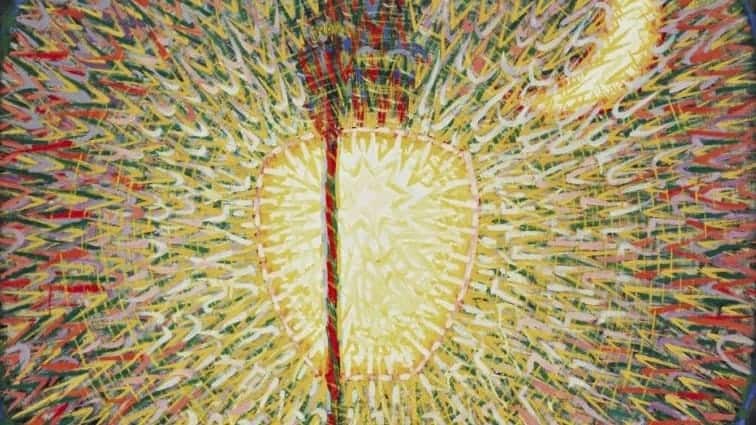
"We declare… a new dazzler, the dazzler of speed. A racing motor car… is more than beautiful than theVictory of Samothrace."
– Futurist Manifesto
Futurism definition: what is Futurism?
Futurism was an Italian art movement of the early 20th century, which aimed to capture the dynamism and energy of the modern world in fine art. Futurists were well versed in the latest developments in science and philosophy and especially fascinated with aviation and cinematography. Futurist artists denounced the past, as they felt the weight of past cultures was extremely oppressive – particularly in Italian republic – and instead proposed an art jubilant modernity and its industry and technology.
Primal menstruum: 1908 – 1944
Key regions: Italy
Cardinal words: move, dynamism, modernity, industry, technology, speed
Cardinal artists: Filippo Tommaso Marinetti, Umberto Boccioni, Carlo Carrà, Giacomo Balla, Gino Severini, Luigi Russolo, Benedetta Cappa, Antonio Sant'Elia
Origins of Futurism
In 1908, the Italian poet Filippo Tommaso Marinetti swerved to miss a cyclist and crashed his car in a ditch. The experience of the old bicycle versus the mod automobile inspired him to write his manifesto of Futurism, a movement that would conquer nostalgia and tradition. By 1910, the young artists Umberto Boccioni, Carlo Carrà and Luigi Russolo had joined Marinetti's movement. They suggested Futurism could reach across simply literature and poetry, and the three artists wrote the Manifesto of Futurist Painters. They sent this to their colleagues Gino Severini and Giacomo Balla, who signed the manifesto. Together, these artists formed the cadre group of Futurist artists.
Fundamental ideas behind Futurism
The Futurists sought to sweep abroad what they believed were outdated, traditional notions near art. Instead, they wanted to replace these with an energetic commemoration of the machine historic period. The key focus was to represent a dynamic vision of the future. As such, they often portrayed urban landscapes and new technologies including trains, cars and aeroplanes. They glorified speed, violence and the working classes, believing they would advance change.
In order to achieve movement and dynamism in their art, the Futurists adult techniques in club to express speed and motion. These techniques included blurring and repetition. They also made use of lines of force – a method which they had adopted from the Cubists. The Futurists worked across a wide range of art forms including painting, compages, sculpture, literature, theatre and music.
Famous Futurists
Major players associated with Futurism in visual arts were Umberto Boccioni, Giacomo Balla, Carlo Carrà, and Gino Severini.
Famous Futurism Artworks
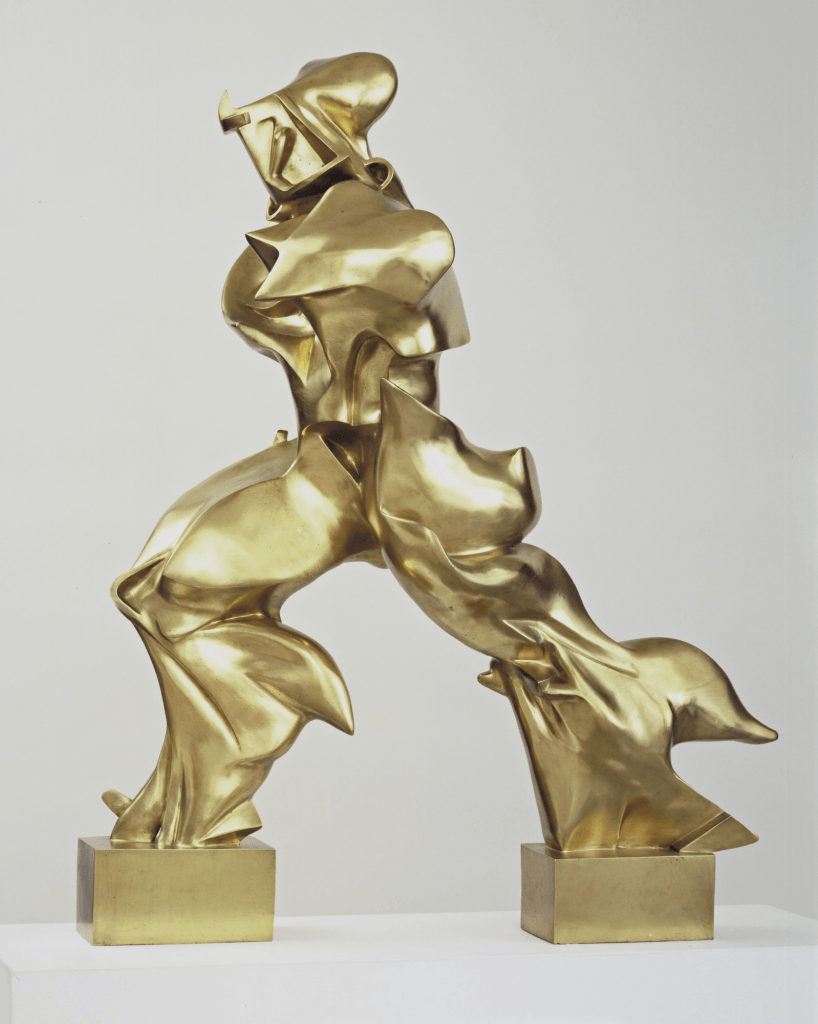
Umberto Boccioni,Unique Forms of Continuity in Infinite (1913)
Arguably the most iconic Futurist artwork always made, Umberto Boccioni'southwardUnique Forms of Continuity in Infinite is a "Cubo-Futurist" effigy striding in forwards movement. The figure's powerful legs seem to be marching ahead, carved by forces such as wind and speed. This modern-man machine can be read every bit an allegory for Italian republic's quest to define itself as a modern nation.
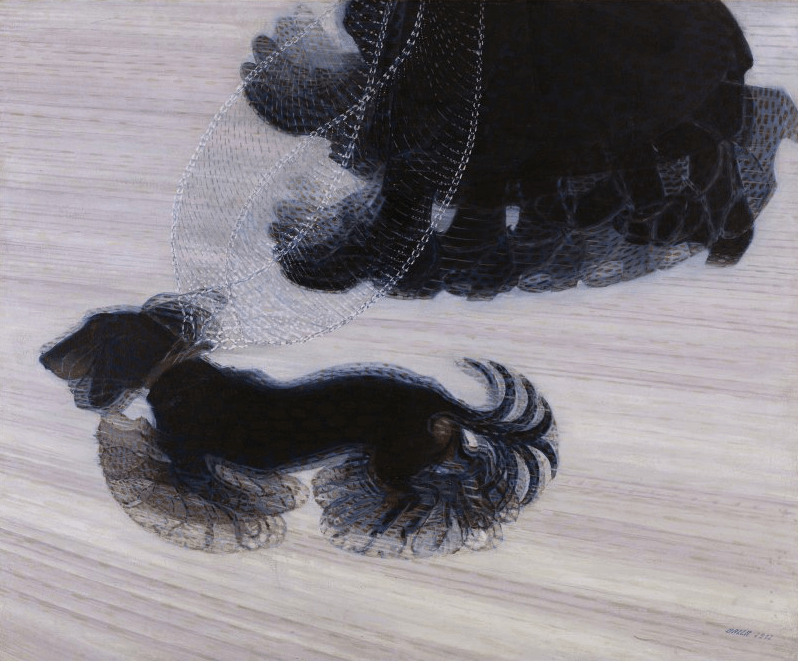
Giacomo Balla,Dynamism of a Domestic dog on a Leash (1912)
Dynamism of a Dog on a Ternion is Balla's best-known work, and shows a dachshund on a ternion and the anxiety of the lady walking it in rapid move. Balla achieved this motion past blurring and multiplication of their legs and feet.
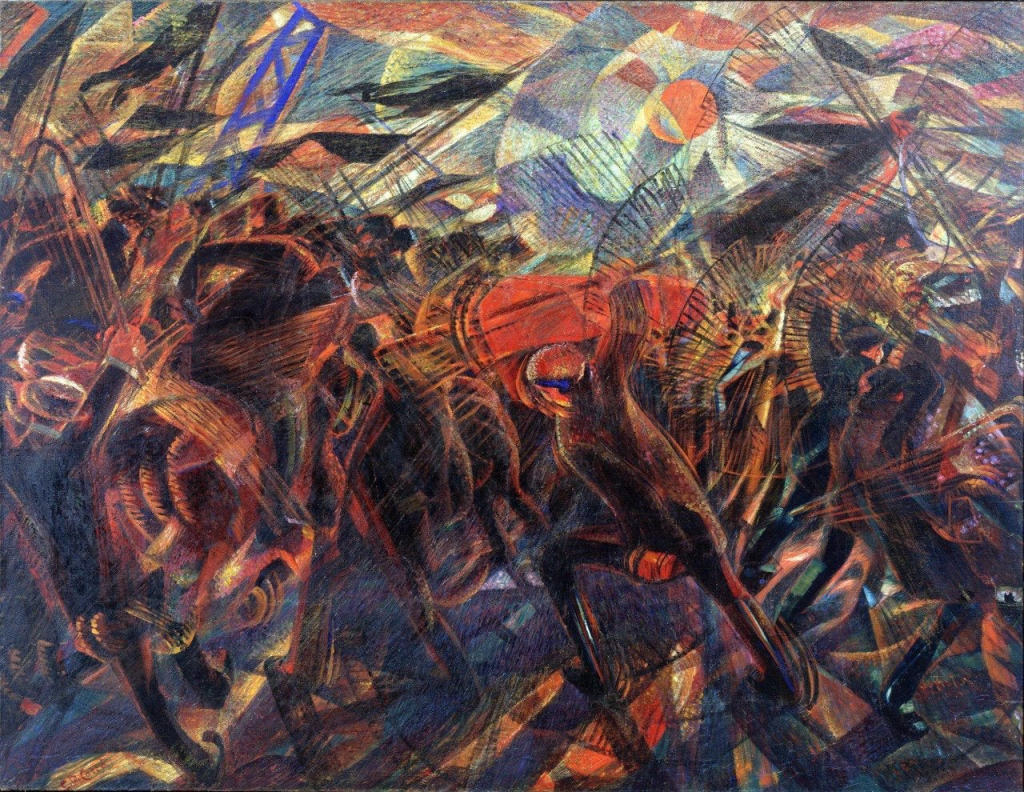
Carlo Carrà,The Funeral of the Agitator Galli(1910–11)
The Funeral of the Anarchist Galli is ane of Carrà's well-nigh famous works. Angelo Galli was an anarchist and labour organiser in Milan who was killed by the police during a strike in 1904. Since they feared that Galli'southward funeral would turn into a political sit-in, the state sent police force to obstruct anarchists from entering the cemetery. When they resisted, police responded with force and a fight broke out. Carrà witnessed the event and captured the intensity and chaos of the scene, as well every bit the rapid motion, in this painting.
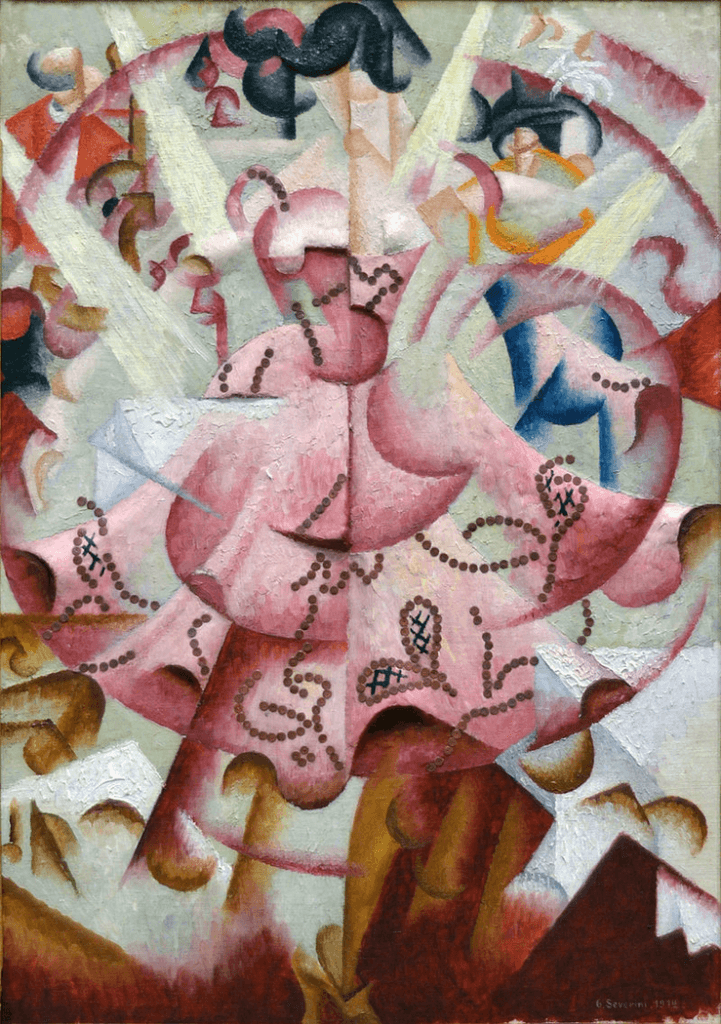
Gino Severini,Dancer at Pigalle (1912)
Gino Severini's dancer is depicted in the centre of the painting and is composed of dynamic intersecting lines and swirling fabric. Concentric circles lead outwards to the edges of the painting, and each circular layer contains fragmentary images of musicians, instruments and audition members. This is meant to capture the essence and dynamism of the operation.
Futurist architecture
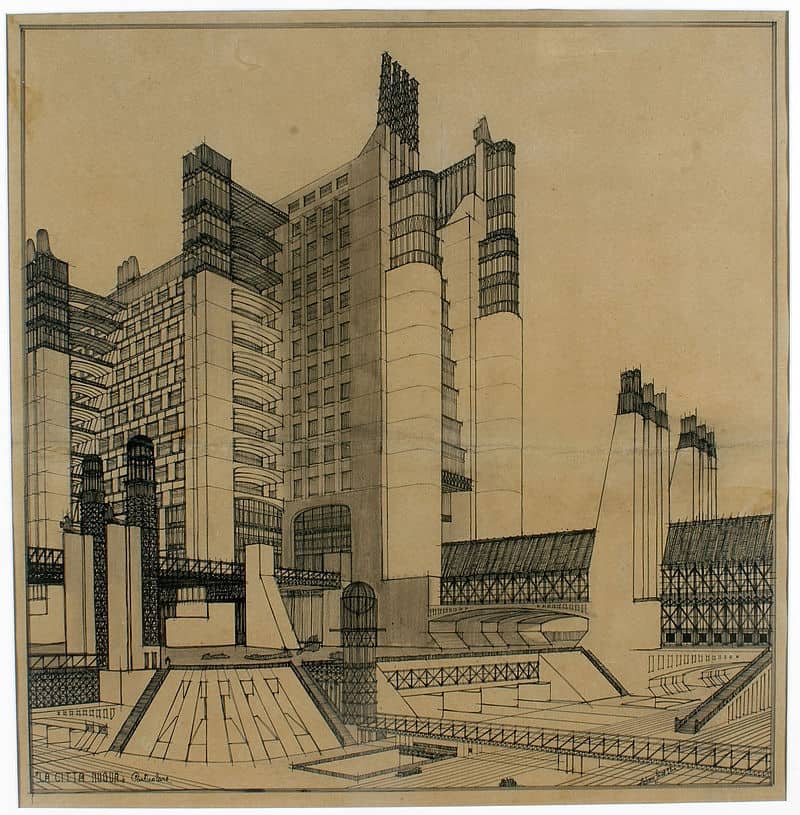
Italian architect Antonio Sant'Elia embraced the twin ideals of mechanisation and motility, proposing a vision of a modern city in the class of a gigantic automobile; he named it Città Nuova ("New City"), a name quite contextually appropriate. This utopian futurist city, designed between 1912 and 1914, was a vast, multi-level, interconnected urban conurbation where massive skyscrapers were integrated by elevators, bridges, and elevated walkways in a constantly evolving artificial landscape.
Paradoxically, Sant'Elia, similar many other Futurists, saw warfare every bit the ways to destroy the old globe and build the much sought after future. However, it was the entropy of state of war itself that would shatter their illusions, destroying not only the socio-economic conditions necessary to facilitate such grandiose plans but besides its primary protagonists – Sant'Elia was himself killed in a battle at the historic period of twenty-eight with nearly no completed works of architecture left behind.
"Standing on the world's meridian we launch once again our insolent claiming to the stars!"
– Futurist Manifesto
The Phases and Politics of Futurism
Futurism was at its near influential and active between 1909 and 1914. During the war, the showtime wave of Italian Futurism came to an end when some members of the group withdrew, and others turned to different styles. Yet, after the Showtime World War, Marinetti revived the group. This revival attracted a new ready of artists and information technology became known as second-generation Futurism.
Futurism is one of the most politicised art movements always to have existed. Many Italian Futurists were supporters of Fascism. They were strongly patriotic, supportive of violence, and opposed to parliamentary democracy. In 1922, when Mussolini came into power, Futurism was officially accepted by the Fascists. As long as the art served to support their political calendar, they were satisfied. After on, later on the fall of Fascism, many Futurist artists were negatively afflicted by their clan with Fascism.
The legacy of Futurism
The Italian Futurists influenced many artists and other fine art movements. Vorticism was inspired past Cubism and Futurism, embracing dynamism, the machine age, and modernity. It is often regarded as the British equivalent to Futurism, yet its founder, Wyndham Lewis, deeply disliked the Futurists. In Russian federation, artists like Natalia Goncharova were embarking on their own Futurist explorations – Russian Futurism is usually considered a separate movement, simply some of its artists did appoint with Italian Futurism.
In the United States, the ground-breaking Armory Show introduced Futurism along with the other European Avant-garde movements to an astonished American audience, ultimately leading to the rise of American Modernism with the evolution of Precisionim, the offset real indigenous modern fine art movement in the Us.
After the horrors of the Commencement World War, many artists were disillusioned past technology and the modern age, which had contributed to this brutal state of war. For this reason, many of them rejected Futurism and started using more traditional approaches. This miracle is described equally the "return to order."
Futurism FAQ
What are the characteristics of Futurism?
The characteristics of futurism are a focus on the technical progress of the modern auto historic period, dynamism, speed, energy, vitality and change.
Who created Futurism?
Futurism was started past Italian poet Filippo Tommaso Marinetti, who wrote the Futurist Manifesto. He was shortly joined by the artists Umberto Boccioni, Carlo Carrà, Luigi Russolo, Gino Severini and Giacomo Balla.
What does it mean to exist a Futurist?
For Futurist artists, the aim was to capture the dynamism and free energy of the modern globe in art. They denounced the past, instead proposing an art that celebrated the industrial and technological developments of the modernistic age.
Relevantsources to learn more
Read more about Art Movements and Styles Throughout History here
Fritz Lang's Metropolis. How the Iconic Silent Film Took Inspiration from Art Movements
Source: https://magazine.artland.com/art-movement-futurism/
0 Response to "Art Movemen in Italy Around 1910 T Express the Energy and Values of the Machine Age"
Post a Comment